How to Preserve Your Life Stories for Your Grandchildren
Jun 03, 2026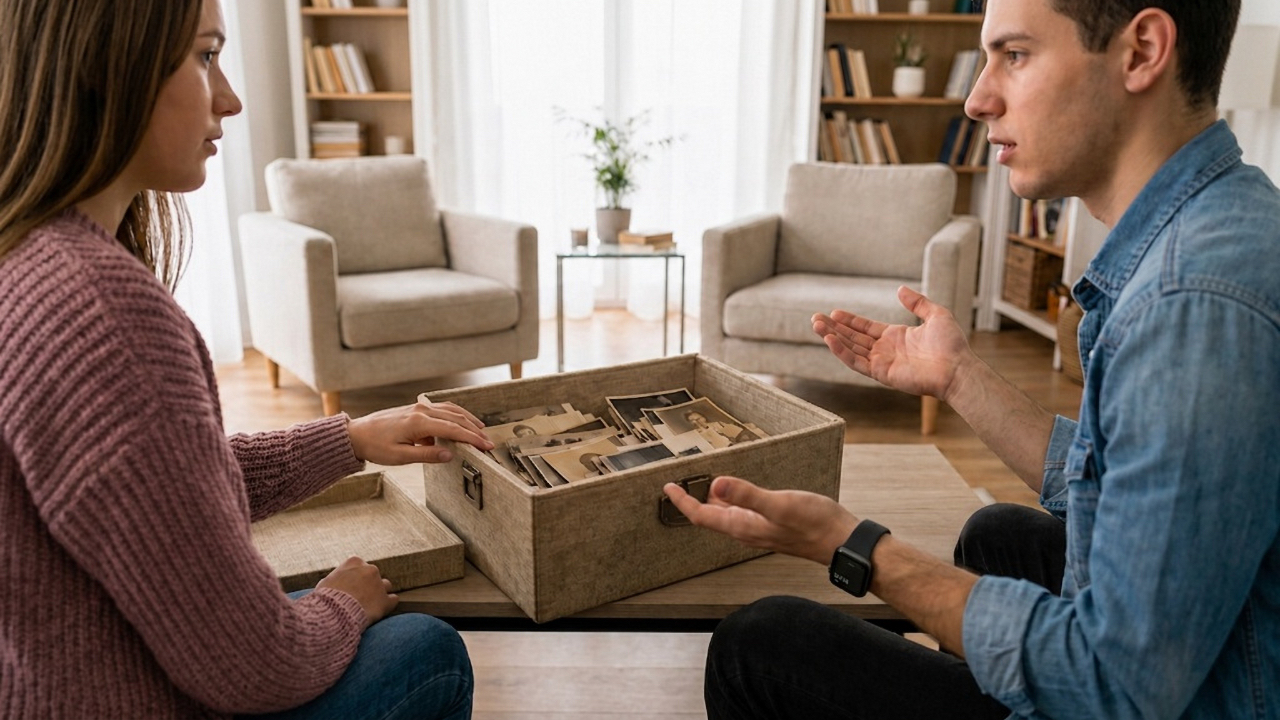
Think about the old handed-down photographs sitting in your home right now — the ones of people you half-recognize, the ones you know nothing about, faces that may look a little like yours but belong to someone whose name you're not even entirely sure of as oftentimes these photos don't have references or even dates written on the back. Just an image, disconnected from any story.
What do you do with the contents of this box or envelope tucked away somewhere? You might hold on to them carefully because you feel they matter even though you're not quite sure why. Or you may feel so disconnected that you decide (often with a bit of guilt or even a heavy heart) to discard these once prized pictures because they no longer hold meaning or any context.
Your descendants do not have to feel that way about you.
Previous generations didn't have what you have today. You are living in the most documented era in human history. You have tools, platforms, and possibilities that your ancestors couldn't have imagined. You can leave behind not just a photograph, but a voice — your actual thoughts, your real memories, the texture of your life as you lived it. Or, you can leave behind your face and your smile, your laugh and the way your eyes light up when you talk about something you love. A flat image frozen in time is one thing. Beautifully written stories, audio recordings of favorite memories or a video of you, alive and present and entirely yourself, are something else altogether. The question isn't whether to leave something behind. It's whether what you leave feels like a treasure chest your descendants will want to keep coming back to, or an obligation they feel they need to politely hold onto in the back of a closet somewhere.
We wholeheartedly encourage you to transform your life stories into a priceless heart legacy and create an invaluable treasure chest your descendants will hold dear and return to again and again!
THE BIGGEST MISTAKE PEOPLE MAKE WHEN PRESERVING THEIR LIFE STORIES
When people think about preserving their life stories, they tend to reach for the résumé version of themselves. Born here, married there, three kids, worked at such-and-such for thirty years, retired, the end. It's accurate. It's also, if we're being generous, a little, umm, dry. And whether those facts are written on a page, spoken into a microphone, or delivered into a camera, the result is the same — a record of a life, rather than a life itself. Big distinction.
Maya Angelou — a woman who understood storytelling the way a surgeon understands the body — once said: "There is no greater agony than bearing an untold story inside you." She wasn't talking about famous people or dramatic lives. She was talking about all of us. Every life contains stories worth telling. The tragedy is when we strip them down to facts and remove everything that make them real and palpable.
The common mistake is distance. People present their lives the way they'd describe them to a stranger at a job interview: polished, professional, slightly guarded. And great-grandchildren, sitting with that document or recording decades from now, will feel that distance. They'll be learning about someone rather than experiencing a connection with someone.
THE SECRET INGREDIENT MOST PEOPLE LEAVE OUT: HOW YOU FELT
Here is perhaps the single most important thing to understand about preserving stories that truly connect — and it's the one most people skip entirely.
It isn't enough to describe what happened. Details matter, no doubt. But what your descendants will remember, what will make them feel like they actually know you, is learning how you felt about things.
Not what you did. How you felt about what you did. Not where you lived. How you felt about that place — the way the light and breeze came through your bedroom window on early summer mornings. The nervousness and pride that swelled the day you started your first job at the tender age of 13. The joy you felt the day you achieved something you worked so very hard for.
This is how human beings actually connect with one another. Not through résumés, not through timelines, not even through photographs — but through the recognition of a shared emotional, human experience. When you experience someone describe the same specific feeling you thought only you had felt, something shifts. That person stops being a stranger. You feel like they took the words right out of your mouth, and they spoke your truth. You feel a connected, kindred kinship, even across time.
That kind of connection requires vulnerability. It requires being willing to say "I felt turned inside out, simply gutted" instead of "it was hard." It requires being willing to say "I loved that man with every cell of my body" instead of "we had a good marriage." It means letting a future great-grandchild see not just the composed, capable version of you, but the version that doubted, that grieved, that sometimes felt overwhelmed by what needed to be done.
This isn't weakness. It's the whole point.
Make no mistake, the people who encounter your stories decades from now will be going through life experiences of their own: losses they didn't see coming, questions you once asked yourself, moments of wondering whether they're doing life right, and countless more. If you show up as someone human and real and a little bit imperfect, they won't just learn about you; they'll feel less alone. And that is a gift that no polished, all-good, feelings-free account could ever give them.
WHAT YOUR GRANDCHILDREN AND GREAT-GRANDCHILDREN ACTUALLY WANT TO KNOW
Here's something that might surprise you: they may be interested but won't care all that much about your career milestones. What they'll be hungry for is something far more intimate.
They'll wonder if you ever felt discouraged. What brought you immense joy. Whether you ever felt completely lost, and how you got through that. They'll want to know what you believed about life when you were twenty, and whether you still believed it at sixty. The road taken, the lessons you wished you had learned earlier, the hardest thing you ever needed to do.
THREE THINGS THAT MAKE A LIFE STORY WORTH KEEPING
So now you know what your descendants are hungry for. But knowing what they want and actually delivering it are two different things. The good news is that none of what follows requires professional training, expensive equipment, or a writing degree. It just requires you.
- Whether written, spoken, or on camera, let it sound like you. This is harder than it sounds, because most of us were taught to present ourselves "properly," which usually means more formally than we actually are. But formality creates distance, and distance is the enemy of connection. The person your grandchildren and great-grandchildren want to know is the one you are in real life, not the one who writes an academic paper or clears their throat and sits up straight when the camera turns on. Your voice, your cadence, your style — that is the most irreplaceable thing you can offer.
- Here's where a lot of people get stuck. They understand that feelings matter, but when it comes to actually putting them into words, they hold back. Honesty isn't just about telling the truth — it's about being willing to be seen. It means being willing to say true things even when they're complicated. You don't have to detail failed relationships or unpack every challenging moment, but you can be honest about your very real struggles and focus on what got you through them. A great-grandchild encountering an ancestor who was wholly human — flawed, fumbling yet striving — will feel far closer to that person than one who seems to have glided through life without a stumble.
- And once you know what to share and have the courage to share it, specificity is what makes it stick. Generals and abstractions slide right off the mind. Specific details stick, and specific moments, told honestly, come alive in a way that is genuinely extraordinary. Don't say, "We didn't have much money." Say, "We split one pork chop four ways and my mother always took the smallest piece and said she wasn't hungry." Don't say, "It was a difficult time." Say, "I remember lying awake listening to the rain on the roof, trying to figure out how we were going to make the next mortgage payment."
Consider the difference between these two descriptions: "I taught fifth grade for thirty-one years at Evergreen Elementary." versus "I taught fifth grade for thirty-one years. Every September I'd stand smiling at that canary yellow classroom door watching the kids file in, some of them so nervous they couldn't look me in the eye. By June, most of them would hug me without being asked. My heart felt warm and full. And if I made any difference at all, I think it was simply this: those kids knew, without a doubt, that I cared about every single one of them. And I feel that lesson was more important than anything I ever wrote on the chalkboard."
In the first, you have a fact. In the second, you have a real person sharing a real-life experience. When you share your stories with that kind of detail, they don't just stick. They breathe.
HOW TO PRESERVE YOUR STORY FOR GENERATIONS YOU'LL NEVER KNOW
This is the part that sometimes trips people up a bit. How do you do this for an audience you don't know, who will be living in a future world we can't even fathom?
The answer is quite simple. You show up for the human things that don't change. You don't try to predict what they might want to hear — you share your stories, in your way, and they will find connections. Times may change and circumstances might alter, but the human condition threads through time.
Consider what that looked like for one ordinary woman in 1952. A woman named Dorothy wrote letters to her husband Jimmy every week while he was away on a six-month construction project. She never thought of them as anything special — just a wife keeping her husband connected to home. She wrote about the children's school plays and scraped knees, Tommy's excitement about getting that term's math award, the neighbour who brought over a casserole when they were all sick, the frost that came early and killed much of her garden, the Sunday she piled all four kids into the car and got hopelessly lost trying to find a new church. She wrote about being tired, about being proud, about the small victories and quiet frustrations of keeping a household running on her own. Jimmy kept every letter in a shoebox under his bed. Decades passed. And one afternoon, Dorothy's great-granddaughter Emily stumbled across that shoebox in her basement, sat down on the floor of her bedroom, and didn't move for the rest of the afternoon. What she held in her hands wasn't just a collection of letters. It was her own great-grandmother, a woman she never met — fully alive, funny, and resilient. A real woman she now felt deeply connected to.
Show up for the person who will someday need to know they're not alone — and trust that your stories, honestly told and bravely shared, will meet them there.
WHY AN HONEST STORY BEATS A PERFECT ONE EVERY TIME
There's a particular kind of paralysis that strikes people when they think about preserving their legacy. They think: I'm not a writer. I don't like how I look on camera. My life isn't interesting enough. I don't know where to start. And so they don't start.
Here's the truth: the great-grandchild or great-great-grandchild who finds your words or watches your video in forty years will not be grading your grammar or critiquing your camera presence. What they will feel in their heart is that you were actually present. That you invested in them. That the person they're encountering was real and loving and intentional. A slightly imperfect, honest recording made from the heart will always feel warmer than a polished one made from behind a wall of self-consciousness. Always.
Don't let the pursuit of perfection stop you from starting. Show up as yourself — your actual self, with your actual memories, your actual lessons learned, and your actual words of encouragement. That is where every meaningful legacy begins.
A question to sit with: What would you want a great-grandchild to know about you that no photograph could ever reveal? What feeling, what moment, what truth about who you really were — would you want them to carry forward into their own life?
If any part of this has stirred something in you, we would love to have a conversation with absolutely no obligation. Just a genuine conversation about your stories, what they hold, and whether we might be the right people to help you bring them to life.
© 2026 Your True Legacy™ / Part of the Inner Wealth Transfer Movement™