How to Preserve Your Life Stories: Written, Recorded, or Both?
May 20, 2026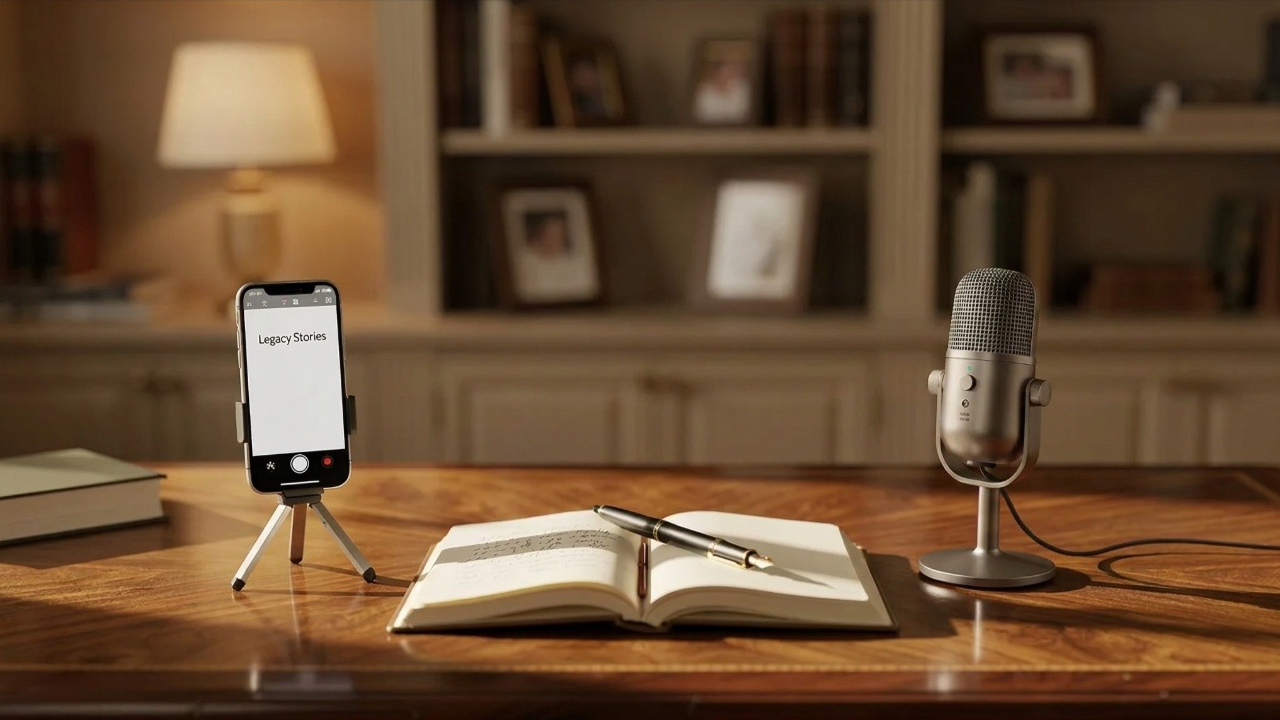
There is no single right answer — only the one that feels true to you.
Most people who think about preserving their life stories don't struggle because they lack stories worth telling. They struggle because they don't know where to begin. The blank page, the blinking cursor, the thought of sitting in front of a camera — any one of these can be enough to put the whole idea off until tomorrow. And tomorrow has a way of becoming never.
If that feels familiar, you are in exactly the right place.
This is not a blog that will tell you what to do. We will walk alongside you as you think it through — because the truth is, there is no single right way to preserve stories. There is only the way that is right for you. And by the time you finish reading, our hope is that you will feel clearer, more confident, and hopefully excited about what is possible.
Brené Brown, in her TEDx talk The Power of Vulnerability, said something that captures why this matters at all: "Maybe stories are just data with a soul." Your life stories are not a collection of facts and dates and events. They are something living — something that carries you forward into the future long after you are gone. And how you choose to preserve them matters.
Written words? Your voice on a recording? A video? A combination of all three? Each carries its own gifts. Each has its own limitations. And each will suit some people beautifully and others not at all. Let's explore them together — honestly, and without pressure.
WHY WRITING YOUR LIFE STORIES IS THE MOST POWERFUL PLACE TO START
There is something quietly powerful about committing your stories to the written word — whether by hand or by keyboard. Writing gives you something no other format can: time. Time to think. Time to choose exactly the right words. Time to say precisely what you mean, and nothing you don't.
When we speak — even from the heart — we can ramble, qualify, and often lose the thread. We say almost what we mean. But writing allows you to reach for the exact phrase that captures a feeling, a memory, a truth. You can cross out, reconsider, return the next morning with fresh eyes. The written word is the only format that gives you the gift of revision — the ability to refine your stories until they reflect not just what happened, but what they meant to you.
Think of Martin Luther King Jr. standing before an estimated 250,000 people in Washington in 1963. His words that day did not feel rehearsed. They felt like fire. And yet they had been carefully crafted, written and rewritten, chosen and refined. That is precisely why they moved a nation. The preparation did not diminish the emotion — it made room for it. Your life stories deserve that same care. When you take the time to write exactly what you mean to express, you are not making your words feel less personal. You are making them more powerful.
And here is something worth remembering: a beautifully written piece, when read aloud with care and intention, whether recorded as audio or spoken on video, carries every bit as much emotional weight as an unscripted conversation. Perhaps more. Because the words have been thoughtfully and carefully chosen. Because nothing has been left to chance. Some of the most moving recordings in existence are simply someone reading, fully engaged and authentically, from something they took the time to carefully write.
There is also a permanence to the written word that technology cannot always guarantee. Paper — kept well — survives centuries. It can be read in a favourite armchair, at a kitchen table, on a patio chair in the late afternoon sun, or tucked into bed at the end of a long day. There is an intimacy in holding a loved one's words on a physical page that is unlike anything else.
WHY RECORDING YOUR VOICE IS THE BEST WAY TO PRESERVE YOUR LIFE STORIES
And yet, if you have ever listened to a recording of someone you have lost, you will understand immediately why audio deserves a place in this conversation.
Your voice is yours alone. The rhythm of how you speak, the pauses you take, the way you say a name — these things cannot be transcribed. They live in sound, and nowhere else.
For children and grandchildren who were too young to truly remember you, or for those who haven't yet been born, an audio recording offers something extraordinary: the feeling of being with you. Of hearing you tell a story the way only you could tell it.
A simple voice recording, even made on a smartphone, requires no special skill and no special equipment. It just requires you to press record and begin.
WHY VIDEO IS THE MOST INTIMATE WAY TO PRESERVE YOUR LIFE STORIES
Of all the formats available to you, video is the one we feel most passionately about encouraging — and here is why. No written page, however beautifully crafted, and no audio recording, however warmly delivered, can fully capture what video can. Your face. Your hands. The way your eyes light up when you talk about something you love. The smile that appears before you even finish the sentence. And your laugh — that completely unique, utterly yours laugh that the people who love you would recognise anywhere, and that no written page could ever hope to capture. These are the things your descendants might search for in their own mirror one day. These are the things that make you irreplaceably, completely you.
Video is, in many ways, the most intimate format of all. It closes the distance between generations in a way nothing else can. A grandchild who never knew you will not just read about you or hear you — they will meet you. They will see you. And that is an extraordinary gift.
We understand that the thought of sitting in front of a camera can feel daunting. Some people feel stiff, self-conscious, or simply don't like the feeling of being filmed. And that discomfort shows — which is precisely why we would never pressure anyone into it. A video where you feel frozen or uneasy does not capture you. It captures your anxiety about being captured. That is not what we want for you, and it will not leave your family a true representation of you.
But here is what we would gently encourage you to consider. You do not need to record everything on video. You do not need to sit down and tell your entire life story to a camera. Even a small amount of video — woven into a larger collection of written words and audio recordings — is infinitely more precious than none at all. Once your great-grandchildren have seen you, they can easily imagine you as they listen to audio or read your words.
So instead of thinking about being filmed, it is often extremely helpful to think about what you love to talk about. Is there a story you have told a hundred times and could tell a hundred more? People who encouraged and helped shape you? A moment in your life that still makes you laugh, or still brings tears? A passion, a craft, a belief you hold deeply? Start thinking about talking about that. Because when you speak about something that lights you up from the inside, the camera disappears. Your essence takes over. And that — that unguarded, alive, fully present version of you — is exactly what the people who love you most want to see. And descendants who will have never met you will get a real representation of you.
The goal is not a perfect recording. The goal is a real one. Even a few minutes of you, speaking freely about something that matters to you, is a gift that will be watched and rewatched for generations. It will be the thing someone reaches for on a hard day. It will be the moment a great-grandchild hears your laugh for the first time — and feels, somehow, that they know you.
HOW TO DECIDE WHICH FORMAT IS RIGHT FOR PRESERVING YOUR LIFE STORIES
There is no universal answer here, and we would never want to give you one. What matters is that you consider yourself honestly — your personality, your family, your circumstances — and choose the path you will actually walk. Because choosing an "ideal" path and not walking it would be a shame. Doing something that you feel comfortable is the absolute key here because we want you to succeed and get it done!
A few questions worth sitting with:
Do you communicate more naturally in writing, or in conversation? When you want to say something important, do you reach for a pen — or a phone?
Who would you like your primary audience to be? Young grandchildren who will want to see you? Grown adults looking for wisdom and who will treasure your words? Future generations who will want to feel connected to a voice from the past?
How do you feel about being recorded? Honestly — not how you think you should feel, but how you actually feel when a camera or microphone is pointed at you?
What do you most want your family to experience when they return to your stories years from now — your words, your voice, your face, or all of these layered together?
WHY COMBINING FORMATS CREATES THE MOST POWERFUL LEGACY
When we work with clients through their legacy journey, we often witness something beautiful happen when formats are layered. A written memoir rich with the kind of detail only you could provide — the feelings, the moments, the texture of a life that no one else lived quite the way you did. A handful of audio recordings carrying the unmistakable uniqueness of your voice — perhaps words of encouragement spoken directly to the people you love, to be heard on a hard day or at a milestone they will reach without you beside them. And perhaps a single video — simple, honest, and entirely yours — where you look into the camera and introduce yourself to the generations who will come after, or speak with all the conviction and feeling you have about the things you are absolutely sure of, the values you hold most deeply, and the messages you want to leave behind.
Each format leaves a different gift — for those who love you now, and for those who will come after you are gone. In the writing, they will discover: here is what I thought and felt and want you to know. In the voice, they will hear: here is how I sounded when I was alive. In the video, they will feel: here is what it was like to sit across from me, with me.
Together, they create something layered — a legacy that can be experienced in different ways, in different moments, by different generations. A great-grandchild may listen to your voice at twelve and read your words at forty and find, each time, something new.
That said — one format done with love and intention is infinitely more powerful than three formats approached with reluctance. Start where you are most comfortable. Begin. That is the most important thing.
Whatever you choose, you are already doing something remarkable. You are deciding that your stories matter — that the people who come after deserve to know where they came from, and who loved them and sent messages of wisdom and encouragement before they existed. That decision, by itself, is the gift.
A question to sit with: If the people you love most could sit with your stories long after you are gone — really sit with them, return to them, be shaped by them — what would you most want them to find there? Your words, chosen with care? Your voice, exactly as they remember it? Your face, lit up by something you loved? Your laugh, catching them off guard on an ordinary day and bringing you back to them, completely and suddenly? Or all of these woven together into something that could only ever be you?
If any part of this has stirred something in you, we would love to have a conversation. Warm and with absolutely no obligation. Just two people who care deeply about this work, ready to listen to you and explore together what your legacy might look like — and whether we might be the right guides to help you capture it and bring it to life.
© 2026 Your True Legacy™ / Part of the Inner Wealth Transfer Movement™