
What Your Grandchildren Will Never Know About You Unless You Tell Them
Aug 12, 2026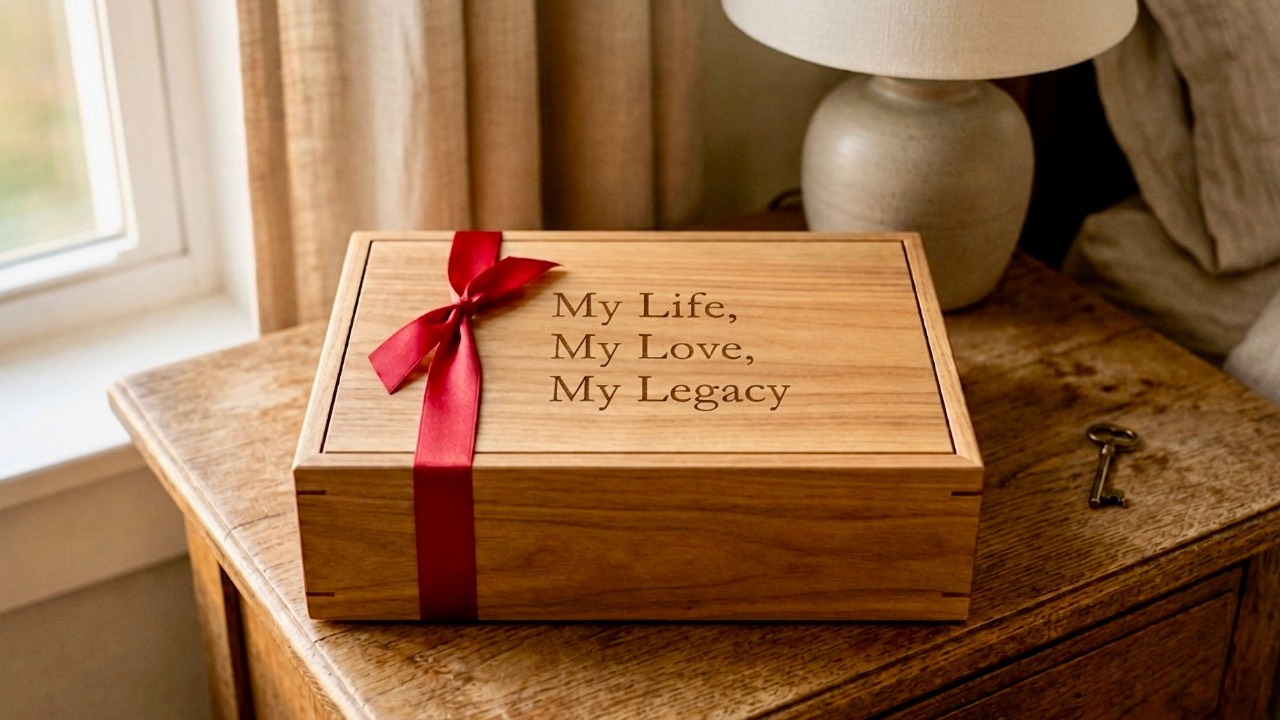
Somewhere in your family, a family tree probably exists in some form. Maybe you're the one who's built it, whether that's a framed print on a wall or a folder of research you've been adding to for years. Maybe you're not the one who built it at all: a cousin, an aunt, or someone else in the family took on that project years ago, and you've seen it once or twice at a reunion. Or maybe no one has ever gotten around to building one, and the full names further back than your grandparents are mostly a guess, or forever gone.
There's also probably a box or album of old photos somewhere in the family, some with names written on the back that half the family can no longer place, and some with no names at all.
However close you've come to any of it, the feeling tends to be similar: names, dates, a line connecting one generation to the next — and often, once those pieces come together, a sense that something is still missing. The thrill of locating a name, or matching a face to one, followed almost immediately by the realization that the name, or the face, is all you got. You know they existed. You still don't know who they were. And it leaves you wanting more.
That gap, between finding someone and actually knowing them, is what this is about.
WHY DOESN'T A FAMILY TREE FEEL LIKE KNOWING SOMEONE?
Genealogy has never been more popular, or more accessible. Records that once required a trip to a courthouse, a church, a county archive, a cemetery to walk row by row searching for a particular headstone, or a port authority to track down a ship's immigration manifest, are now searchable from a couch. And there is something genuinely moving about it: confirming that a person existed, tracing a line back through wars, border crossings, ocean voyages, and impossible odds to arrive, eventually, at you.
But sit with what a record actually gives you. A birth year. A marriage license. An occupation, usually one word: laborer, seamstress, clerk, teacher, physician. A death certificate. None of it tells you what she believed in strongly enough to build a life around, or what kind of person she was when no one was watching. None of it tells you what he was willing to sacrifice for, or the work ethic he lived by that no one ever needed to ask of him.
"In all of us there is a hunger, marrow-deep, to know our heritage."
— Alex Haley
Haley spent years tracing his own family's history before writing Roots. A record may satisfy the search. However, it cannot satisfy that hunger of wanting to know even more. Only stories can do that, and only the person who actually lived them can share their feelings, perceptions, and takeaways.
WHAT ABOUT DNA TESTS AND ETHNICITY PERCENTAGES?
Millions of people have mailed in a vial of saliva expecting to feel more connected to their history once the results came back. There's real reason for that expectation, as this generation has access to ancestry information no one before us has had: percentage breakdowns by region, migration patterns going back centuries, even matches to living relatives who share a portion of your DNA. These tools are a genuine blessing to a lot of people, and they've reconnected families who might never have found each other otherwise.
But finding a living relative isn't the same thing as finding out who your great-grandmother really was, let alone hearing it directly from her. That third cousin might share part of your DNA and still know no more about your great-great-grandfather than you do, or perhaps nothing at all. Reaching out to someone can feel like its own hurdle. Sending an awkward message to someone who never expected to hear from you can be uncomfortable. And not everyone who receives it is glad to be found either. However, when it goes well, what you've gained is a remarkable thing: a new relationship in the present, someone who might become a real part of your life going forward. Even then, that relationship is with someone living today — not with the ancestors you set out to find. Those ancestors are still gone, and nothing about this new connection really changes that.
A percentage tells you where blood traveled from. A match tells you who else is carrying it. Neither one tells you what any of those people actually believed, feared, or loved enough to risk everything for. You can know your ancestry down to a decimal point, be in touch with relatives you never knew existed, and still know nothing about the person a few generations back who made the decision that landed your family in the country it calls home now. The tools are impressive. What they can't do is tell you who anyone actually was.
WHEN THE PAPER TRAIL ENDS, IS DIGITAL ENOUGH TO PRESERVE YOUR LEGACY?
Genealogists have a name for the moment research stops producing anything new: a brick wall. The last known record, the last traceable name, the point past which there is simply nothing left to find, no matter how many databases get searched or how many distant cousins get messaged.
It's a useful phrase, because it says outright what a family tree usually leaves unsaid: that it has limits. Nearly every tree hits a brick wall eventually, not because the people before that point didn't matter, but because official records were never designed to hold more than the basic facts of a life, even for the names they did manage to keep.
With modern technology, you likely won't hit a brick wall of missing records. You'll hit something else entirely. Where earlier generations left behind a scarcity of records, most people today are leaving behind an abundance of documentation: photos, videos, texts, posts, far more of daily life captured than any birth certificate ever could.
Yet, incidental footage and an intentional legacy aren't the same category of thing. Having a candle blown out on camera, or twenty-five minutes of a Christmas dinner captured for good, is genuinely wonderful; footage like that becomes more precious with every year that passes, not less. But the videos from birthdays and holidays stored in your phone weren't created to carry your wisdom forward. Even when they're captured on purpose, they typically are captured to document a moment. Someone could watch every minute of them fifty years from now and still never receive your inner wealth: the lessons you learned the hard way, the advice you'd want passed down, or the words of love meant for someone still to come.
"Videoing moments and documenting your Life Stories produce two entirely different levels of connectedness — one captures memories. The other captures the treasures of your inner wealth."
— Maja Maurer & Jamie Schafer
WHAT MEMORIES ACTUALLY LAST ACROSS GENERATIONS?
Dr. Krystine Batcho, a psychologist at Le Moyne College who has spent decades studying nostalgia, found something worth noting: the memories that give people the deepest sense of continuity and meaning aren't the dramatic ones. They're the small, sensory, specific ones, the ones that felt like nothing at the time. Nostalgia, her research shows, isn't idle sentimentality. It's a psychological anchor, something that steadies a person by connecting who they are now to who they've always been.
That's true for the person who lived the memory. But Emory researcher Robyn Fivush has found that the same anchoring effect can extend to someone who wasn't there at all. She calls it the intergenerational self: a child who knows enough about the people who came before them develops a sense of identity shaped by lives they never personally witnessed — lives that reach forward into who that child becomes. A grandchild who knows exactly what moments sounded, and smelled, like — the particular high-pitched whistle of the copper tea kettle, the hollow thumping of the screen door, the smell of fresh-cut wood and glue in a workshop — isn't just collecting a fact. These are the kinds of details that make someone feel like they belong to a story bigger than the one they're living.
The details don't need to be remarkable. They need to be true, and specific enough to make someone who wasn't there feel like they were.
WHAT STORIES CAN ONLY YOU TELL?
Every life contains moments that people around you experienced only from the outside. Their perspectives weren't wrong, but they were shaped by what they could see and what they were living through themselves. Even so, an outside view can only ever capture what showed, never the whole story underneath it. Only you were on the inside of your own experience.
Maybe, at some point, you've walked away from a relationship or a marriage everyone assumed was solid.
From the outside, it looked like a simple choice. You left. That's usually where the story stops for everyone else.
What that choice actually held is rarely so simple. Sometimes the real reason was one that was much too complex and difficult to try to explain. Sometimes it was tangled up with someone else's story, and telling it honestly would have meant compromising your own values to speak about them at all. And sometimes some people, especially children or young adults, hadn't experienced life enough yet to understand something that complicated. Others might have been too emotionally invested to be able to view the situation objectively. A simpler version of the story became the one everyone was told and people settled on. And for some, this abbreviated and simplified version might be just fine to leave as is. But for others, it may be equally important to tell their truth and expand understanding.
Whether someone wants to revisit and expound upon the event or not, the important part is this: it's not the version that necessarily matters. What matters is that in every event there is an opportunity for learning and growth. The lessons you've learned contain wisdom, and that wisdom can help and lift someone in the future. Telling your stories, your perspectives, your a-ha moments is something only you can do.
None of that exists in a document, nor can it be found in a photo album. Your perspective and experience live only in you, and if you don't share them, they end when you do.
WHAT ABOUT THE HEIRLOOMS THAT DO GET PASSED DOWN?
Somewhere in most families, an object survives, but the story around it doesn't. A ring, carefully stored in a drawer for years, taken out and looked at now and then. A tool, kept clean and in its place in the garage, long after anyone remembers who it actually belonged to. A timeless pearl necklace, passed down since your great-grandmother's day, though no one remembers whether it marked her eighteenth birthday, her engagement, or something else entirely, and no one knows what it actually meant to her.
And yet, when the right moment comes — a milestone birthday, a graduation, a wedding — these are often the objects that get pulled out and gifted. We treat them as precious because passing them down honors the person who is gone, and receiving them is an honor in its own right. Even so, they would mean so much more with the story attached: the occasion it marked, the reason it was chosen in the first place.
That tends to hold especially true for small, personal items like jewelry. Furniture and larger keepsakes are a different matter these days. A recent Globe and Mail piece captured this directly: a woman in her late 70s wrote about coming to terms with the fact that her adult daughters don't want her belongings, not because they don't love her, but because their tastes differ and their homes are already full. Jodi Eisner, a certified professional organizer who has helped families downsize since 2001, has seen the same pattern play out again and again: heirlooms get passed from attic to basement to someone else's basement, until they land with someone who finally says they don't want them.
With furniture and larger pieces specifically, some people don't place value on them because the style doesn't suit their own homes, because there's no room to keep them, or because they'd rather have something modern and fresh. For others, it's simpler than that: the object carries no story, so it carries no significance.
The object survives on its own. The meaning behind it, all too often, dies with the person who could have explained it — unless the story gets attached before it is too late.
Wouldn't it be incredible to give future generations something they'd actually want to keep, something that means the world to them? An inner wealth legacy barely takes up any space, never goes out of style, and never depends on someone else's taste to be treasured. It's simply irreplaceable to receive and cherish a small box that can sit on a bookcase, or be tucked away in a buffet or nightstand, containing written work or USB sticks with audio recordings and videos.
HOW DO FAMILY MEMORIES FADE ACROSS GENERATIONS?
Watch how this actually plays out. After you've passed away, the people who knew you best could talk about you for an hour without running out of material — not just what you did, but how you did it, and what you sounded like while doing it. They could capture a good portion of the fullness of who you actually were.
One generation removed, that same fullness compresses. What remains is an impression: a phrase people remember you saying, a story told at gatherings until its edges are worn smooth. Real, but shorter and thinner. Two generations removed, even that impression starts to flatten: less a person you could picture and more a few words used to describe one — someone who was, apparently, kind, or strict, or funny, according to whoever is left to say so.
This isn't a failure of love. It's simply what happens to a life that was never captured in the person's own words. Each generation holds a little less of the texture and a little more of the outline, the way a photograph left in sunlight slowly loses its color, until eventually there's a shape where a face used to be.
It doesn't have to happen. It only happens by default, which means it also has the capacity to stop the moment someone decides to fill in the colors instead of leaving an outline.
WHAT DOES A FAMILY RESEMBLANCE ACTUALLY TELL YOU?
People say it constantly, half joke and half wonder: "You have your grandmother's eyes," or "You smile and light up a room exactly like Grandpa used to." But the comment doesn't always stop at appearance. Sometimes it's a trait instead: "You've got your great-grandfather's grit." That kind of connection can feel even more real than a physical one, since it isn't something a person can see in the mirror; it's something they only find out by being told.
Either way, the comment alone can only carry so much. A great-grandchild who hears they inherited your resolve still wants to know what that determination actually looked like in practice and where it got you. What future generations are hungry for isn't proof that you had everything figured out. It's proof that the parts of themselves they don't always know what to do with, the same grit, the same fight, were already part of a life lived before their own, and it turned out just fine.
HOW TO LEAVE A LEGACY FOR FUTURE GENERATIONS
Starting doesn't take the kind of courage you might be picturing. No one is asking you to have lived through something headline-worthy, or to shape your life into a story built for the stage.
There's a particular kind of settling that often sets in later in life, a sense that the years of building, providing, and shaping things are behind you now, and nothing left ahead feels like it's truly yours to shape, just yours to live out. That feeling is a lie, but it's an understandable one, because our culture rarely tells you what role is still yours to grow into once the working, raising, and striving years are done.
Here's what that culture leaves out: there is one transformation still available to you, and it may be the most significant one of your life. Not a new skill or a new chapter of doing. A change in what you are, to the people who come after you. The moment you sit down and intentionally hand over what you actually learned, not just what happened to you, you stop being simply "Grandma" or "Grandpa," someone loved and eventually deeply missed. You transform your role into that of a guardian. You become someone who deliberately created something invaluable to be carried forward with purpose. Your purpose continues to comfort, console, teach, guide, uplift, and encourage those here now, and those yet to come. You remain an active presence and a grounding influence for generations you will never meet.
That kind of transformation doesn't require anything you haven't already lived. It requires the decision to stop keeping what you've earned and learned to yourself, and instead begin creating your precious inner wealth legacy gift.
Joseph Campbell spent his career studying the shape every great story takes: a call, trials survived, and finally a return, where the hero comes home and hands over what the journey taught them. Campbell had a word for what gets carried back, the boon, a gift meant not for the hero alone, but for the people still waiting at home. You've already lived the first two parts, the call and the trials. You've spent decades becoming who you are, and all that is already behind you. What remains is the return, coming back with your Life Stories, and sowing them forward into the hands of your loved ones — both those here now and those still to come. Campbell was clear on this point: even the most remarkable journey isn't over until the hero comes home with what they found.
"A hero is someone who has given his or her life to something bigger than oneself."
— Joseph Campbell
The hero's journey has always needed someone willing to make the return. Your family may not even know yet what they're missing. You can be the loving relative who thoughtfully and intentionally invests the boon, to be carried forward.
A question to sit with: If your love could keep guiding someone long after you're gone, what's the first thing you'd want it to say?
Becoming a guardian of your own Life Stories doesn't have to happen alone. Let's talk about what that could look like for you.
© 2026 Your True Legacy™ / Part of the Inner Wealth Transfer Movement™