
Why Did We Stop Passing Down Wisdom to the Next Generation?
Oct 07, 2026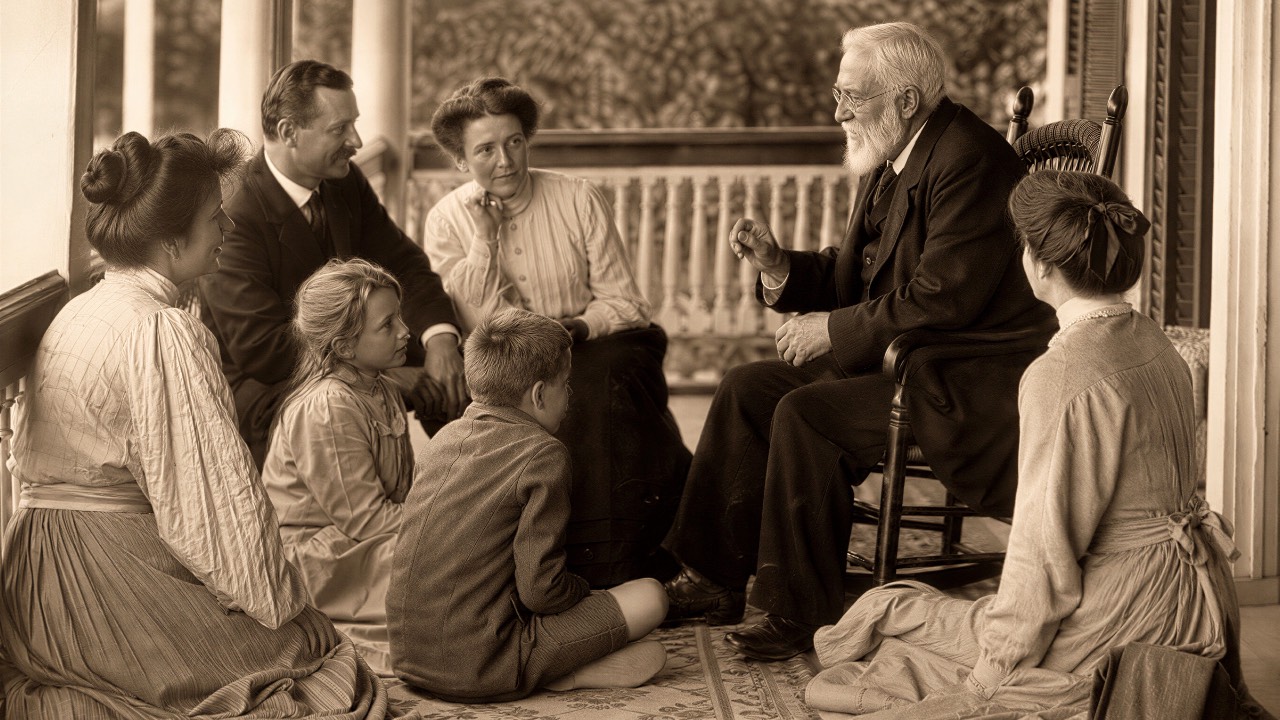
Think about the hardest year of your life. Most of us don't have to search long to find it. Now think about who knows the real story of that year. Not the short version you tell when it comes up, but how you actually got through it. Has anyone younger than you ever asked? Ever come to you on purpose, looking for your advice, or asked if you could set aside an afternoon for a real heart-to-heart?
If you had to pause, you're not alone. For many of us, it's hard to remember the last time anyone did. And it's usually not because the younger people we love don't care. Something bigger has shifted.
Somewhere along the way, many of us lost the habit of going to our elders for guidance. Elders slipped from their place as trusted advisors. Their knowledge started to feel out of date in a world that seemed to change faster every year. And generations started drifting apart, spending most of their days among people their own age. Today, many younger people turn elsewhere for advice: quick clips on social media, a search bar, even a conversation with AI.
None of this happened because anyone decided wisdom stopped mattering. It happened gradually, over decades, almost without anyone noticing. And all the while, the understanding you've earned over a lifetime of living — what failure taught you, how you found your footing after loss, what you'd tell your younger self — goes largely unshared.
You carry those things. They're your Inner Wealth, your true legacy. And chances are, very few people have ever heard them.
It wasn't always this way. For most of human history, societies in nearly every region of the world built formal, honored roles around the people who safeguarded what mattered and handed it forward. West African griots, Irish bards, and Lakota keepers of history are only a few examples. We explored those traditions in more depth in "The Ancient Tradition of Passing Down Wisdom."
Now for the harder question. If intergenerational wisdom was once treated as essential, what happened to it? And why does bringing it back matter more now than it has in generations?
HOW DID SCHOOLS AND INDUSTRIALIZATION CHANGE THE ROLE OF ELDERS?
In 1955, sociologists Talcott Parsons and Robert Bales published Family, Socialization and Interaction Process, one of the most influential studies of the American family of its era. Many observers at the time pointed to rising divorce rates and falling birth rates as signs that the family was falling apart. Parsons and Bales argued something different. As industrial society grew more specialized, work and teaching that households once handled on their own moved out to factories, offices, and, crucially, schools. What remained inside the home was a narrower set of responsibilities, centered on raising children and offering emotional support.
That shift brought real gains. Formal schooling opened doors for millions of children, and few of us would want to undo it. But it also came with a cost that was easy to miss. When work happened at home or on the land, children learned beside the older people who did the work: parents, grandparents, neighbors, and masters of a trade. They learned hour after hour, season after season. Practical skills and life lessons traveled together, because the same people taught them in the same places.
Once the paycheck came from somewhere else and learning moved into the classroom, school became the recognized authority on education. The teacher's word often carried the final say, and that sent children an unspoken message: what they learned from their elders counted for less. Over time, elders lost their role as everyday teachers, and with it, much of their place as trusted advisors.
"From my grandfather Verus I learned good morals and the government of my temper."
— Marcus Aurelius, Meditations (trans. George Long)
In most homes, no one made a conscious decision to let this go. The role simply stopped being structurally necessary, one generation at a time, until an entire cultural muscle had atrophied.
WHY DOES ELDER WISDOM SEEM OUTDATED TODAY?
The second shift was about speed. In 1969, anthropologist Margaret Mead gave a series of lectures that became her book Culture and Commitment. In it, she described three kinds of culture. In the first, change is slow enough that children learn mainly from their elders, and the future looks much like the past. In the second, change moves fast enough that people start learning mainly from their peers. In the third, which Mead believed was just emerging, change is so rapid that elders begin learning from the young.
Most of us have lived through Mead's third stage. Picture a grandparent handing a phone to a grandchild and asking for help. Multiply that small moment across millions of households and several decades, and a quiet message settles in: the older generation's knowledge belongs to a world that no longer exists. But wisdom isn't a quick fix or a skill that expires with the next software update. It takes a lifetime to earn, yet somehow our recognition of its value has largely faded in just a few generations.
The trouble is that two very different things got lumped together. Knowing how to use the latest technology is information, and information goes out of date quickly. Wisdom is something else entirely. A grandmother may not know how to set up a streaming account, but she may know how to start over after losing everything, how to tell a friend a hard truth without losing the friendship, or how to love someone through a difficult season. That kind of understanding doesn't expire. Yet when older people's technical know-how started to look outdated, many assumed, at great cost, that their wisdom had gone out of date along with it.
"With the ancient is wisdom; and in length of days understanding."
— Job 12:12 (King James Version)
WHY DO YOUNGER AND OLDER GENERATIONS SPEND SO LITTLE TIME TOGETHER?
The third shift was about distance. Sociologists Gunhild Hagestad and Peter Uhlenberg have written extensively about what they call age segregation. In a widely cited 2005 paper, they showed that outside of the family, people's social networks in the United States and the Netherlands are made up largely of people their own age. In a follow-up study, they described contemporary Western societies as separated by age in their institutions, their neighborhoods, and their culture, with the family standing as one of the few institutions that still bring generations together.
Think about how true that feels. From the very start, schools sort children by birth year rather than by readiness or ability, so most of a child's day is spent with people born within a few months of them. Sports teams and summer camps are often grouped by age, too. Many neighborhoods become known as places for young families or for retirees. And while retirement communities and senior care homes offer real benefits, they also mean that many older adults spend most of their days among people their own age, with fewer natural chances to cross paths with younger generations. As a result, many of us can go long stretches without a meaningful conversation with someone decades older or younger.
When the generations do come together, it's usually for a reason. Holidays, weddings, and funerals gather everyone in one place, but the day revolves around ceremony, food, and celebration. Churches, mosques, synagogues, and other places of worship welcome people of all ages, yet they gather to worship, not to seek out an elder's advice. Volunteering works the same way, where the task at hand rightly comes first. So, the generations do meet, but those moments are few and far between, and even then, there's rarely room for the kind of long, open conversation where wisdom gets passed along.
DO OTHER CULTURES STILL RESPECT THE WISDOM OF ELDERS?
It helps to be clear about where this decline happened. Much of what's described above is a distinctly Western pattern, one that took hold earliest and ran deepest in the modern era. In many other places, elder-centered wisdom is not a historical curiosity. It is still part of daily life.
In many societies shaped by Confucian thought, filial piety, the duty and respect children owe their parents, remains an active expectation. In China, that expectation is taken seriously enough that a revised national law on the rights of older people, which took effect in 2013, requires adult children who live apart from their parents to visit or send greetings frequently. The law never defined "frequently," and it drew plenty of understandable online mockery. But the fact that it was written into law at all says something about how central that relationship remains there, and about how much pressure rapid modernization is putting on it.
In other places, elders are not only respected but still turned to for guidance. Across Central Asia, elders known as aksakals, a Turkic word meaning "white beards," hold a recognized place in community life. Research on communities in the region continues to describe their opinions as central to decision-making. Kyrgyzstan went a step further. In 1993, drawing on that older custom, it established courts of elders to help settle local disputes, and in 2002 it gave those courts a detailed legal framework. Similar patterns have been documented across many African communities, where elders have long played a leading role in passing knowledge from one generation to the next through the spoken word.
Scholars are candid that these roles are under strain, too. A recent study using intergenerational focus groups in Cameroon found that modernization is now challenging older adults' traditional place as keepers of knowledge. The same forces that reshaped Western households are arriving almost everywhere. The West simply felt them first, which is why the loss there feels so complete. In many other places, they arrived later, and elders still hold much of their traditional role. That tells us something important: the decline of elder wisdom isn't a law of human nature. It's a cultural shift, not an inevitable one, and the exciting part is that what a culture lets fade, it can also choose to restore.
WAS THE PAST REALLY BETTER AT PASSING DOWN WISDOM?
It would be easy to romanticize the past, so it's worth being honest here. The formal wisdom-keeping roles of earlier eras weren't universal. Many served particular lineages, courts, or communities rather than everyone. And plenty of ordinary wisdom went unrecorded and was forgotten long before anyone owned a smartphone.
So the past wasn't perfect. What it had, and what many of us have lost, was a shared belief that passing down wisdom was worth doing. That belief is worth bringing back.
WHY DOES WISDOM FROM ELDERS MATTER MORE IN THE AGE OF AI AND SOCIAL MEDIA?
Mead was describing a world of television and early computers. The pace of change she saw has only accelerated. Today, a young person wondering about love, money, work, or heartbreak doesn't need to walk across the room or pick up the phone. Answers arrive instantly, in a thirty-second clip or an endless scroll.
Some of that advice is genuinely helpful, even thought-provoking. There are skilled professionals online — counselors, doctors, financial planners, educators — sharing careful guidance with millions of people. But even the best of it is made for everyone, which means it's made for no one in particular. An algorithm may know your age bracket well enough to fill your feed with advice aimed at people like you, but it can't know your history, your temperament, or what you're actually walking through. And alongside those professionals are countless voices with no particular expertise at all, whose advice travels because it's catchy, confident, or trending. Sometimes it gets followed simply because everyone else seems to be following it.
The newest advisors aren't people at all. In the spring of 2025, Common Sense Media surveyed a nationally representative group of 1,060 American teens ages 13 to 17. Nearly three out of four had tried an AI companion, a chatbot designed for personal conversation, and more than half used one at least a few times a month. About one in three had used AI companions for social interaction and relationships, including friendship and emotional support. All of this happened almost overnight. Only a few years ago, confiding in a chatbot would have sounded like science fiction. Now it's part of growing up for many teens, and researchers are only beginning to study what it means, over the long term, for a young person to turn to a machine for something that feels like care.
A feed or a chatbot can produce an endless supply of advice, encouragement, even something that sounds like warmth, on command, in seconds. What it can't give you is your grandfather telling you honestly about the business he lost before he built the one that lasted. Or your grandmother describing the winter she raised three children on her own, and how she summoned the strength to get up each morning, even on the days she nearly didn't. That kind of wisdom lands differently. It's rare. It's real. And it comes from someone who loves you.
And stories are only part of it. An elder can offer something no algorithm can: the sense that you are worthy just as you are, with nothing to prove, and that you can be imperfect and still be loved. A young person growing up surrounded by synthetic voices may need, perhaps more than any generation before, to hear a real one. Someone who came before them, telling them who they are and what they're capable of. That voice can reach them even from a grandparent they never got to meet, if that grandparent took the time to leave their words behind. And there's inherent value in that alone: knowing that someone, long before you could ever thank them, intentionally and lovingly invested in you.
HOW CAN YOU START PASSING DOWN YOUR WISDOM TODAY?
This isn't meant to alarm anyone. But it is urgent. Every year, countless stories and lessons, along with a lifetime of hard-won wisdom, are lost with the people who carried them, often simply because no one thought to ask, and no one thought to share. Waiting for the wider culture to fix this won't work, because a culture is the sum of the people in it. It shifts one person at a time, starting the moment each of us decides this matters. And that can begin with you, right where you are, today.
The first step isn't choosing the right format or finding the perfect words. It's committing to the process. Many of us already treat one handoff as essential: the financial one. We make the appointments, sign the papers, and see it through. Your Inner Wealth, the wisdom you've gathered over a lifetime, deserves at least that same commitment. Decide whom you're passing it on to, set aside time on a regular basis, and keep going. You don't have to figure out the rest alone. Throughout our other posts, you'll find plenty of guidance, prompts, and ideas to help you along the way.
That's what creating your true legacy is all about: making sure what you've learned is cherished, kept, and carried forward by the people who come after you.
If a spouse, partner, friend, or anyone else came to mind as you read this, send it their way. They're carrying wisdom someone will one day be grateful to have.
The tradition of passing down wisdom went largely dormant. It did not go extinct. And it's waiting for someone willing to pick it back up, in their own voice. Let that someone be you.
A question to sit with: If someone younger asked you for a heart-to-heart today, how would that make you feel?
If you'd like support creating Your True Legacy, we'd love to have a conversation to explore whether we might be the right guides to help you.
© 2026 Your True Legacy™. All rights reserved.
Part of the Inner Wealth Transfer Movement™